Industrial capacities of Ukraine: directions, current state, export potential
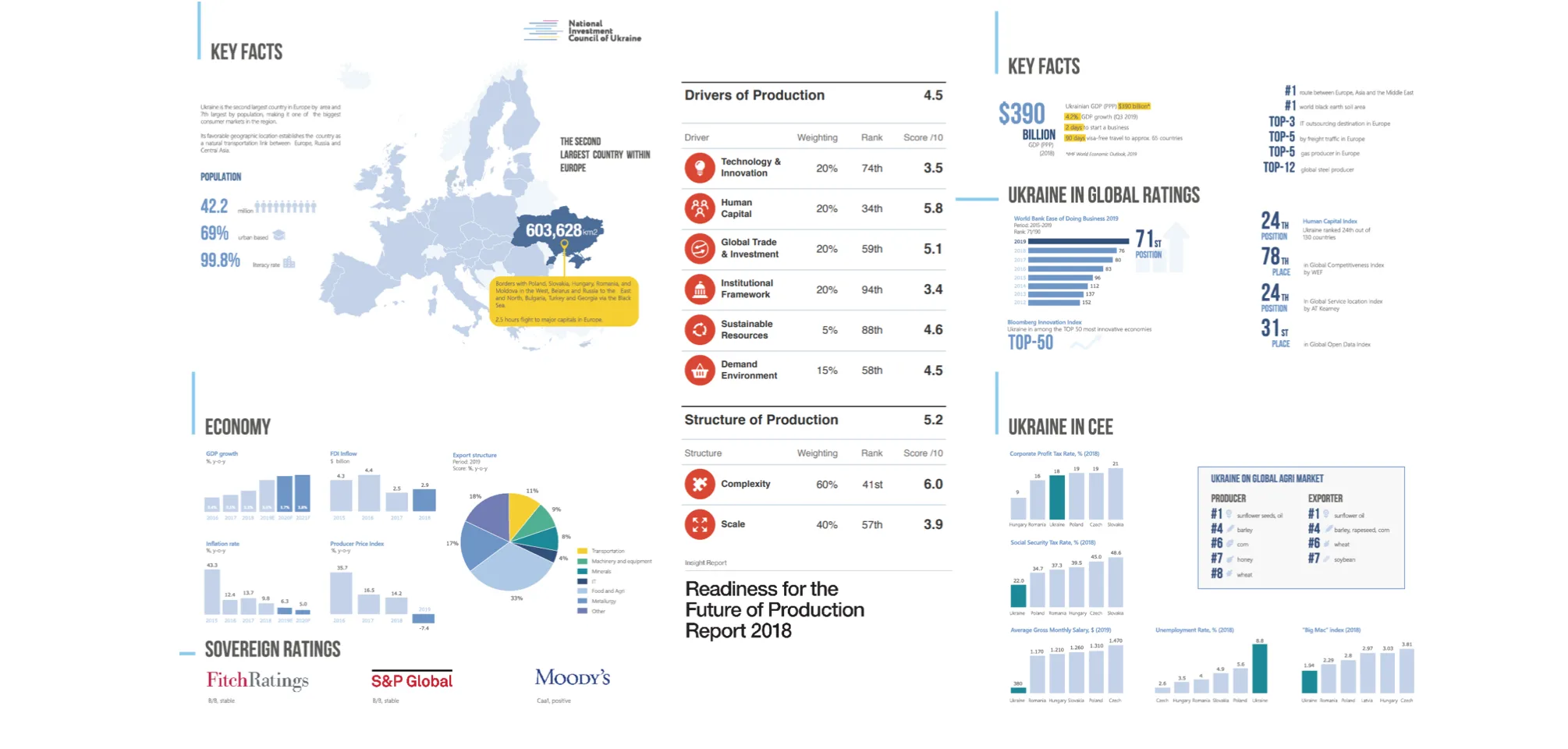 Key indicators of Ukraine's export potential. Sources: Readiness for the Future of Production Report 2018 и Ukraine. Time to Invest (Davos2020)
Ukraine's industry ranks 60th globally in terms of production volume, with $22 billion or 0.151% of the global industrial output. The majority of the country's economy is made up of agriculture, mineral extraction, food processing, light industry, chemicals, and metallurgy. Approximately 301% of the country's output is exported. The country's technological base is largely outdated and in need of modernization. This necessitates collaboration with international partners to implement Industry 4.0 technologies.
In this article we will take a look at five branches of industry in Ukraine, analyzing the following points:
- Export structure, volume, and directions.
- Current status: salaries, profitability, production volumes.
- Prospects for start-up of new export-oriented enterprises in Ukraine
Metallurgy. Manufacturing of finished metal product
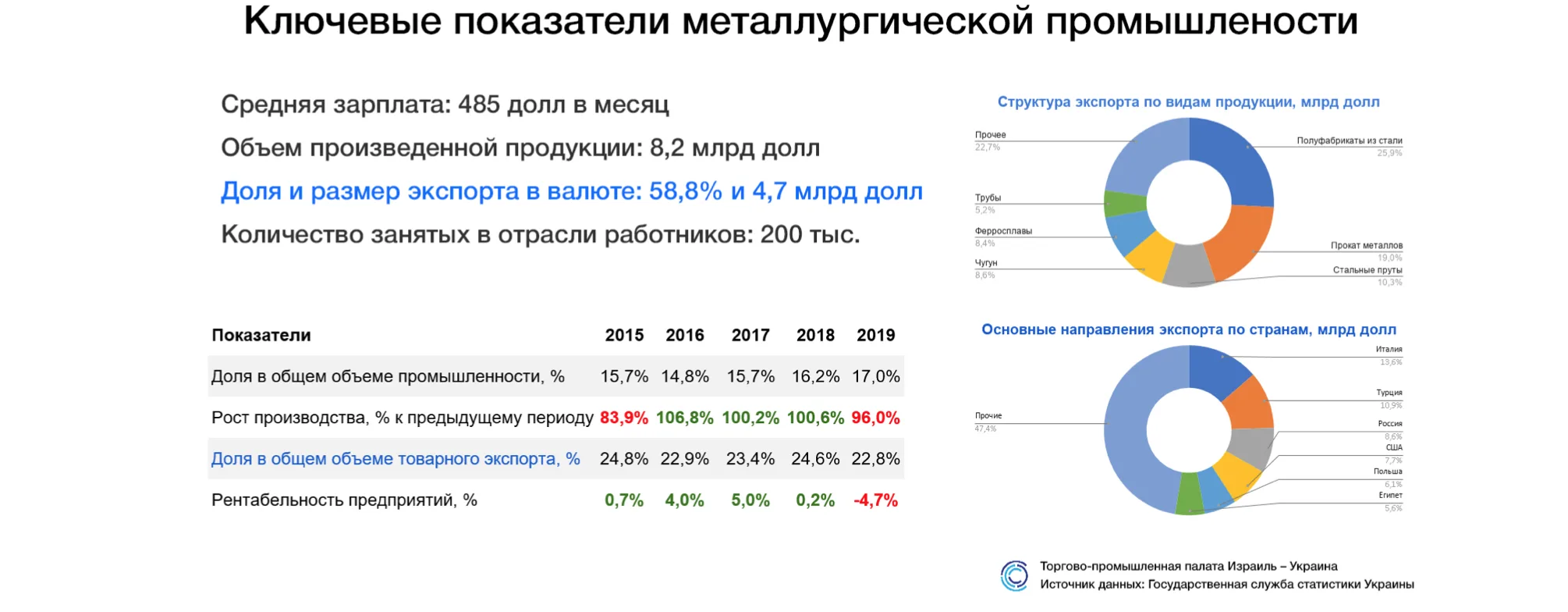 Metallurgical industry of Ukraine: key facts, structure and export directions. Source: State Statistics Service of Ukraine
Current state The metallurgical industry in Ukraine provides up to 17% of the total volume of industrial products sold, a fifth of merchandise exports and 4.7 billion dollars of export revenue, 200 thousand jobs and about 10% of the total average number of full-time employees in the industry.
Almost all production is accounted for by large enterprises such as: «Azovstal Iron and Steel Works», «Dniprospetsstal», «Donetsk Iron and Steel Works», «Zaporizhstal», «ArcelorMittal» and «Dniprovskyi Iron and Steel Works». Together, they produce 25.5 million tons of cast iron, 21.1 million tons of steel, 11.3 million tons of rolled products and 1.1 million tons of pipes, tubes and hollow profiles made of steel.
Advantages of Ukraine. When comparing Ukraine with other countries as a platform for launching metallurgical enterprises, the following competitive advantages stand out:
- Proximity to importing countries: Europe and the European part of the Russian Federation share common borders, Türkiye is 620 km away by the Black Sea, Ashdod is 2,500 km away by sea.
- Lower average salary in the industry: $485 per month compared to $920 in China, $1,250 in Poland, and $690 in Russia.
- Free trade zone with EU countries, Canada, Israel and Turkey.
- Accessibility and ease of connection to the power grid (many factories in the country have closed, but communications remain).
- Proximity to sources of raw materials.
Another less obvious advantage of Ukraine is its outdated technological base (the share of obsolete and technically obsolete equipment is 50-70%). Launching a new production facility with modern equipment could provide a local advantage over existing Ukrainian enterprises and the opportunity to capture a portion of the domestic and foreign markets.
In addition, Ukraine began to apply the provisions of the pan-Euro-Mediterranean Convention in 2019, which allows, for example, an Israeli manufacturer to purchase raw materials in Ukraine, import them at a reduced or zero duty rate and then sell the finished product to the EU countries, maintaining the status of preferential origin.
Chemical industry
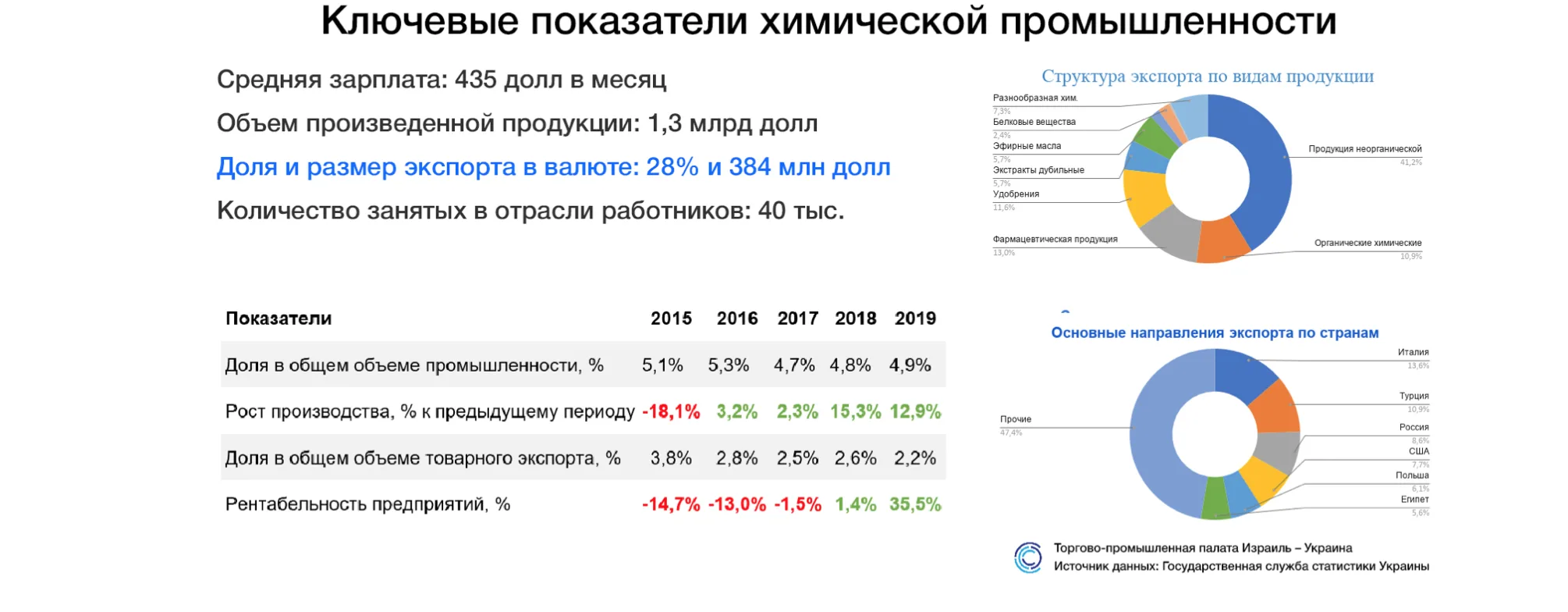 Chemical industry of Ukraine: key facts, structure and export directions. Source: State Statistics Service of Ukraine
Current state. The share of the chemical industry in total production volume of Ukraine is 4-5%, which is significantly lower than in other countries (for comparison, the share of chemical products in developed countries is from 8 to 13%). Reason for the gap:
- conflict in Eastern Ukraine, beginning in 2014, in course of which Ukraine lost control over the part of the territory that contained the country’s raw materials deposits and significant chemical facilities;
- obsolete technology base;
- breaking production chains after the dissolution of the USSR.
As for the structure of production, it is mainly goods with low added value: fertilizers and nitrogen compounds, synthetic rubber and plastic. The fallowing largest enterprises are concentrated in this segment:
- Ostchem Holding Group: PAT «Azot» (Cherkasy), PrAT «Rivnoazot» Rivne), PrAT «Severodonetsk Azot Association» (Severodonetsk). Their share in the production of fertilizers and nitrogen compounds, synthetic rubber and plastic is from 15 to 17% over the years.
- Enterprises of AT «Ukragrohimholding»: PrAT «Dniprovskyi Mineral Fertilizer Plant» ( Kamianske), PrAT «Eco-Azot» (Cherkasy).
- PAT «Odessa Port Plant» (Yuzhne).
- PrAT «Himdivision» (Kamianske).
- AT «DniproAzot»(Kamianske).
- PAT «Sumykhimprom» (Sumy).
These enterprises account for about 22% of total production and 37% of the employed workforce in the chemical industry of Ukraine. Considering the industry as a whole, small businesses account for 16% ($156 million), medium-sized enterprises for 72% ($936 million), and large for 12% ($208 million). This is generally a normal ratio that meets the criteria of a competitive market.
Advantages of Ukraine. For potential investors considering relocating chemical production to Ukraine, the following advantages will be available:
- Free trade zone with the EU countries, Canada, Israel and Turkey. Participation in the pan-Euro-Mediterranean Convention;
- proximity to sources of raw materials and sales markets;
- ease of connection to electrical networks;
- low cost of labor.
Production of rubber and plastic products, other non-metallic mineral products
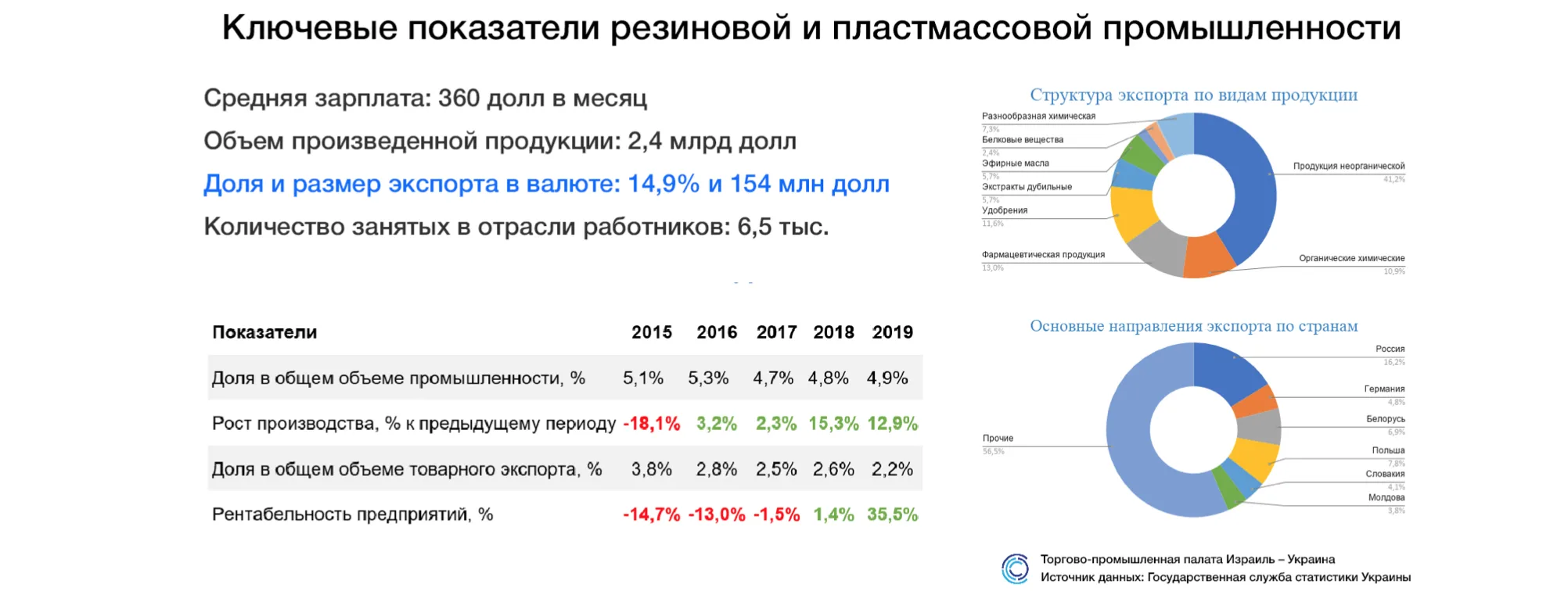 Rubber and plastics production in Ukraine: key facts, structure, and export trends. Source: State Statistics Service of Ukraine
Current state. Regarding rubber production, Ukraine primarily produces tires, pipes, insulation materials, seals, hoses, footwear, rubber crumb, tiles, rubber compounds, and more. Leading tire manufacturers are Dniproshina in Dnipro and Rosava in Bila Tserkva. Rosava, for example, can produce over 6 million tires annually. Rubber products are manufactured at small and medium-sized enterprises in Lysychansk, Sumy, Zaporizhzhia, Odesa, Kharkiv, and Donetsk.
Plastic manufacturing is scattered throughout Ukraine and is mainly focused on packaging goods, accessories, metal-plastic products, parts for various devices and vehicles.
Advantages of Ukraine.
Primary advantages:
- Free trade zone with the EU countries, Canada, Israel and Turkey. Participation in the pan-Euro-Mediterranean Convention;
- Proximity to plastic importing countries (EU and Russia);
- Almost empty plastic recycling market, i.e. a lot of cheap raw materials;
- Cheap labor.
Manufacturing of computers, electrical and optical goods
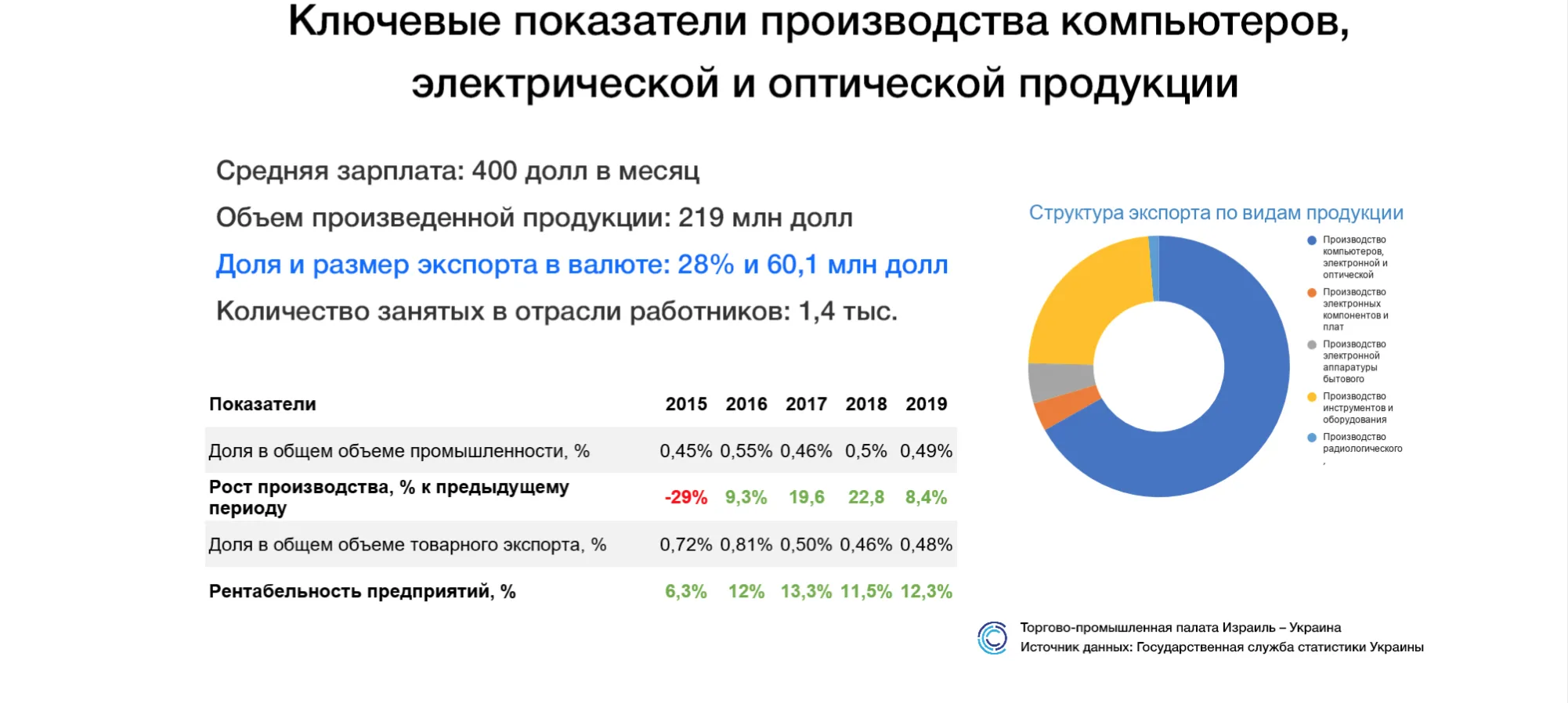 Precision engineering in Ukraine: key facts, export structure. Source: State Statistics Service of Ukraine
Current state. This industry is almost undeveloped. There are three reasons: the first is the legacy of the Soviet Union, which relied on heavy engineering, the second is the lack of investment, and the third is the cheap import of computers, phones, cameras, and other gadgets. All that is available in Ukraine in terms of precision engineering is the production of photodiodes, phototransistors, semiconductors, cables, and measuring devices.
Advantages of Ukraine. Main:
- a large number of high-level technical personnel who are in demand abroad, but are almost not in demand within Ukraine;
- Free trade zone with the EU countries, Canada, Israel and Turkey. Participation in the pan-Euro-Mediterranean Convention;
- Cheap labor.
Wood product manufacturing. Paper production.
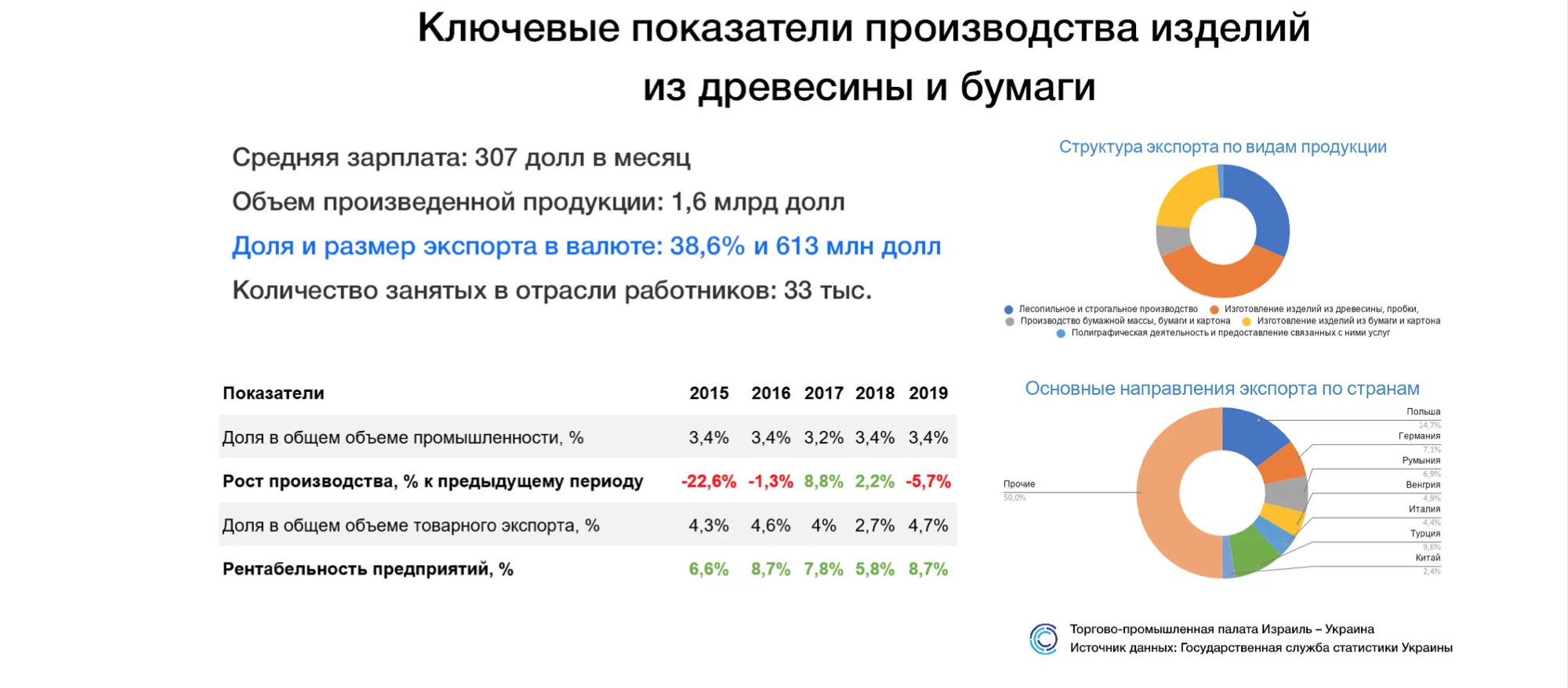 Ukraine's Woodworking and Paper Industry: Key Facts, Structure, and Export Directions. Source: State Statistics Service of Ukraine
Current state. The wood processing industry's share in the country's industry is low—3.41% of the total. The sector fails to meet domestic market demand for most product types. This is primarily due to a limited raw material base: low forest cover (forests occupy only 1.41% of Ukraine's territory), the predominance of forests with limited commercial value, and low logging rates. Domestic raw material sources cover only a third of the industry's needs; the rest is imported (mainly from Russia).
The main export articles of Ukraine are raw wood, or roundwood (2.5 million tons) and fuel wood (2 million tons), which is exported to the EU. Having said that, it should be noted that the official data of the fiscal services of Ukraine do not coincide with the data from the EU importers. The actual export volume may be much higher.
Key directions of the woodworking industry in Ukraine:
- Sawmill industry. Supplies the lumber. The enterprises are concentrated in Chernivtsi, Berehomet, Broshniv, Vyhoda, Rakhiv, Svaliava, Stryia — in the Carpathians; Kostopil, Kovel etc. — in Polissia.
- Plywood industry. The most types of plywood are made from birch. The main manufacturing capacities are concentrated in Lviv, Kostopil, Rivne and Orzhiv.
- Chipboard industry. The chipboards are manufactured for the needs of the furniture industry mainly in forest areas. The largest centers are Kyiv, Svaliava, Kostopil and Teresva.
Overall, the industry produces more than $ 1.6 billion worth of products. There are 2,600 active enterprises, among which are only 3-4 large ones (their share is 0.1% of the total number of enterprises in the industry), 145 medium-sized (5.6%) and 2440 small enterprises (94.3%), which corresponds to the conditions of safe competition.
The pulp and paper industry of Ukraine has about 100 enterprises that produce paper, cardboard and goods made of this materials, and more than 300 processors, traders and other accompanying enterprises. The volume of production is about 700 million dollars, 25% of which is exported.
Advantages of Ukraine. From the main points:
- zero rates on the import of raw materials, except for bark and products made from it (rate 5%);
- proximity to importing countries (EU, Türkiye, Russia);
- Free trade zone with the EU countries, Canada, Israel and Turkey. Participation in the pan-Euro-Mediterranean Convention;
- Cheap labor.
Furthermore, according to the RCA indicator, in 2016, Ukrainian wood products were twice as competitive as the global average (2.14). By this indicator, they were ahead of such global exporters as China (0.67), the United States (1.20), Germany (1.11), Russia (1.38), and Malaysia (0.89), and slightly behind Poland (2.19).
Let's sum it up
Against the backdrop of the trade war between the US and China, as well as rising wages in traditional manufacturing hubs in East Asia, Ukraine has all the conditions and potential to become an alternative location for industrial capacity in most sectors of the global economy. This is facilitated by:
- High human potential: 50th place out of 175 in Human Capital Index rating from the World Bank.
- Excellent conditions for localizing IT-related businesses: 20th place in the Global Services Location Index 2019 by A.T. Kearney.
- Continuous improvements in the business environment: 152 place in the World Bank Doing Business ranking in 2012 and 64th place in 2020.
- Data openness: 31st place in the Global Open Data Index (as of June 2020).
- Fight against corruption: 142 place in Corruption Perceptions Index Ranked 125th in 2019 by Transparency International in 2014.
- Distribution of power grids across the country: total length of over 800,000 kilometers.
- Low labor costs.
- A free trade zone with EU countries, Canada, Israel, and Turkey. Participation in the Pan-Euro-Med Convention. This will allow Israeli manufacturers exporting to the EU market to purchase raw materials in Ukraine, import them at reduced or zero tariffs, and then sell the finished goods to EU countries while maintaining their preferential origin status. This also opens up the possibility of relocating production facilities to Ukraine.
The Chamber of Commerce and Industry Israel-Ukraine will be glad to assist Israeli business representatives in establishing and developing trade and economic ties with Ukraine. If you have any questions, you can contact us using the contact details provided on our website.
You may also like
Solrom Holdings Ltd.: Interview
Vlad Cherkassky, CEO of the Chamber of CCI Israel-Ukraine, spoke with Matan Rabin, CEO of Solrom Holdings Ltd., which has recently joined the Chamber as a member.

Israel-Ukraine Chamber of Commerce and Industry at the Mlieko & Med ’25 Forum in Bratislava
On May 24, 2025, the Israel-Ukraine Chamber of Commerce and Industry took part in the Mlieko & Med '25 forum.
Become a Chamber member
Join a business community that opens new opportunities for partnership, growth, and cooperation between Israel and Ukraine.